

 Sign Up/Log In



lbf vs lbs for Springs: What’s the Difference?
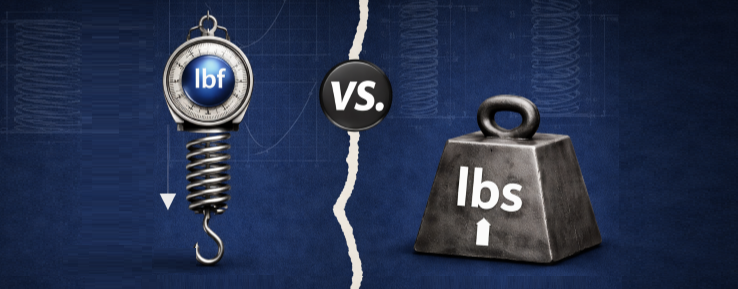
If you compare spring specifications, you’ll often see loads listed in lb or lbs and spring rates listed in lb/in. In engineering drawings or aerospace documentation, those same values may appear as lbf and lbf/in. This short guide explains the difference and when it matters.
Quick Answer
- lbf (pound force) is the technically correct unit for spring load and spring rate.
- lb & lbs (pounds) is the common commercial convention and is widely used in spring catalogues.
- On Earth, the numbers are the same; the difference is about precision and context, not performance.
What Does lbf Mean?
lbf stands for pound force, a unit of force defined using standard Earth gravity. Springs exert and resist force, which makes lbf the correct unit for:
- Spring load and maximum load
- Initial tension (extension springs)
- Load at solid height
- Spring rate (lbf/in)
- Torque (in-lbf)
Because it clearly means force, lbf is preferred in engineering drawings, regulated industries, and aerospace specifications.
What Does lbs Mean?
lbs is the everyday plural of pound. Technically it refers to mass, but in commercial practice it is commonly used to mean pounds of force.
That’s why most spring catalogues list:
- Spring load in lb or lbs
- Spring rate in lb/in (sometimes written as #/in)
- Torque in in-lb or in-lbs
This convention is long established and works well for most commercial and industrial applications.
lbf vs lbs (In Practice)
- Different meaning: lb/lbs is informal; lbf explicitly means force
- Same numeric value on Earth: 25 lb = 25 lbf
- Catalogue usage: lb, lb/in, in-lb
- Engineering usage: lbf, lbf/in, in-lbf
No conversion is needed for normal Earth-based spring applications.
When to Use Which
Use lb or lbs when:
- Selecting springs from commercial catalogues
- Communicating with standard spring suppliers
Use lbf when:
- Creating engineering drawings or specifications
- Working in aerospace, defense, or medical devices
- Unit clarity and dimensional correctness matter
What About Space or Low Gravity?
On Earth, “lbs” and “lbf” match numerically because they assume standard gravity. In low gravity environments:
- Mass stays constant
- Weight changes with gravity
- Using plain “lb” becomes ambiguous
Springs always respond to force, so for space or planetary applications, spring loads and rates should be specified as lbf (or Newtons) to avoid confusion.
Spring Rate Units
Spring rate is force per unit length:
- Correct engineering unit: lbf/in
- Common catalogue unit: lb/in
- Metric equivalent: N/mm
Summary
- lb & lbs are common and acceptable in commercial spring catalogues and communication.
- lbf is the precise engineering unit for force.
- Both are numerically equal on Earth, but lbf removes ambiguity in high-accuracy applications.





.png "Lee Spring Logo")